
This function uses MCMC to sample from the posterior distribution of the standard Bradley–Terry model. Standard model means that there are no tied comparisons and no player or comparison specific variables. This provides a fast implementation of the standard model. A multivariate normal prior distribution on the player quality parameters can be specified.
Usage
speedyBBTm(
  outcome = NULL,
  player1 = NULL,
  player2 = NULL,
  win.matrix = NULL,
  player.prior.var = NULL,
  lambda.initial = NULL,
  n.iter = 1000,
  hyperparameter = TRUE,
  chi = 0.01,
  psi = 0.01,
  burn.in = 100,
  n.thin = 1,
  verbose = interactive()
)
Arguments
- outcome
Vector of outcomes. 1 if player 2 is the winner, 0 if player 1 is the winner.
- player1
Vector of first players.
- player2
Vector of second players.
- win.matrix
(optional) A win-loss matrix where the i,j th element is the number of times object i beat object j.
- player.prior.var
(optional) A matrix specifying the prior covariance of the player correlation parameters.
- lambda.initial
(optional) A vector containing the values of the player correlation parameters for the first MCMC iteration.
- n.iter
The number of MCMC samples to be drawn.
- hyperparameter
A boolean indicating if inference should be performed for the prior variance hyperparameter. If TRUE the prior variance (main diagonal of the covariance matrix) must be set to 1.
- chi
(Optional) The rate parameter for the inverse-gamma prior distribution on the hyperparameter. Default is 0.01.
- psi
(Optional) The shape parameter for the inverse-gamma prior distribution on the hyperparameter. Default is 0.01.
- burn.in
(optional) The number of iterations to discard as burn-in. Default is 100.
- n.thin
(optional) The number of iterations to thin the MCMC samples by. Default is 1.
- verbose
(optional) A boolean indicating if progress should be printed to the console. Default is
interactive()therefore progress is shown if run interactively, but disabled in non-interactive contexts.
Value
An "mcmc" object containing samples from the posterior distribution.
Details
If player.prior.var is omitted, independent and identical
N(0, 1^2) prior distributions are placed on each object quality parameter.
If lambda.initial is ommitted, it is set to a vector of zeroes.
Examples
# \donttest{
########################################
## Forced Marriage in Nottinghamshire ##
########################################
# Construct covariance matrix based on spatial information
prior.var <- expm::expm(forcedMarriage$adjacencyMatrix)
prior.var <- diag(diag(prior.var)^-0.5) %*% prior.var %*% diag(diag(prior.var)^-0.5)
# Fit model
# Using `n.iter = 3` here to reduce runtime, you will need more
# iterations for inference.
forcedMarriageModel <- speedyBBTm(
outcome = rep(1, length(forcedMarriage$comparisons$win)),
player1 = forcedMarriage$comparisons$win,
player2 = forcedMarriage$comparisons$lost,
player.prior.var = prior.var, n.iter = 3, burn.in = 0
)
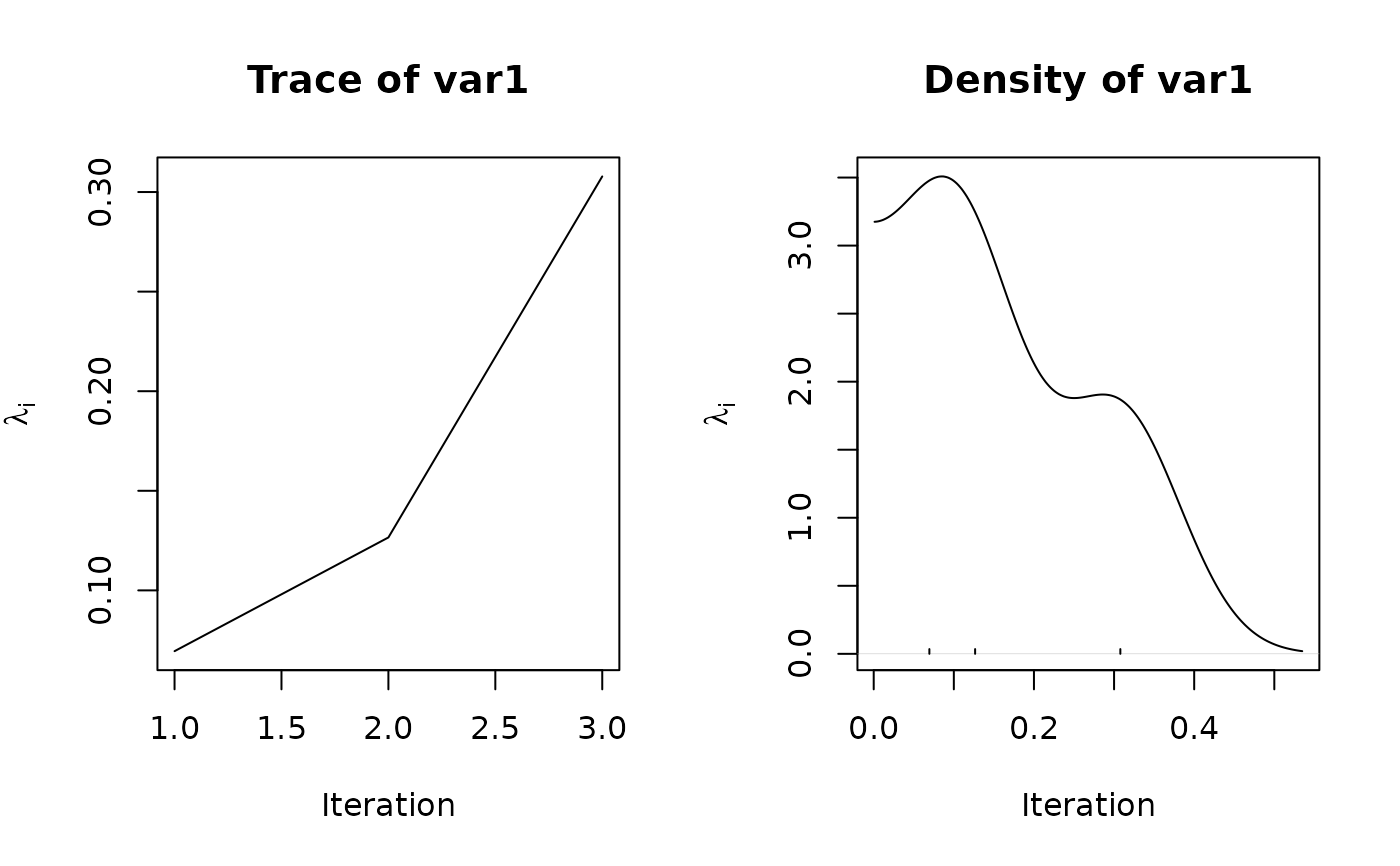
# Plot results
plot(forcedMarriageModel[, "lambda[1]"],
xlab = "Iteration", ylab = expression(lambda[i])
)
 # }
# }